
Key takeaways
- Start with a real business problem and clear success metrics—don't build a solution looking for a use case.
- Fine-tuning or RAG will get you there faster than pretraining from scratch, unless you have massive data and compute budgets to justify it.
- Automated evaluation beats gut checks every time. Set up testing that maps back to business outcomes you can measure.
- Security, privacy, and governance aren't afterthoughts. Bake them in from the first prototype.
The Big Picture
This guide walks you through deploying LLMs in a business setting—from figuring out what problem to solve all the way to running models in production. Teams that follow a structured approach tend to see 40% faster time-to-value and 60% better user adoption than those who wing it.
Getting real results from LLMs means lining up what the technology can do with what your business actually needs. We cover how to choose your architecture, evaluate model performance, and set up the right guardrails so your LLM deployment works at scale and delivers results you can point to.

Where LLMs Pay Off
The best LLM projects start by finding use cases where the payoff is obvious and measurable. Most businesses see returns through productivity gains, better customer interactions, and smoother operations.
- AI copilots: Automate customer support, assist with operational workflows, or speed up financial analysis
- Internal knowledge assistants: Use RAG to let employees search and query your own documentation and institutional know-how
- Developer and analyst tools: Code generation, data analysis helpers, and automating repetitive internal workflows
Tie every LLM initiative to specific numbers: average handle time, customer satisfaction scores, ticket deflection rates, or cycle time improvements. Measure your baselines before you build so you can prove the ROI with real data afterward.

Picking the Right Architecture
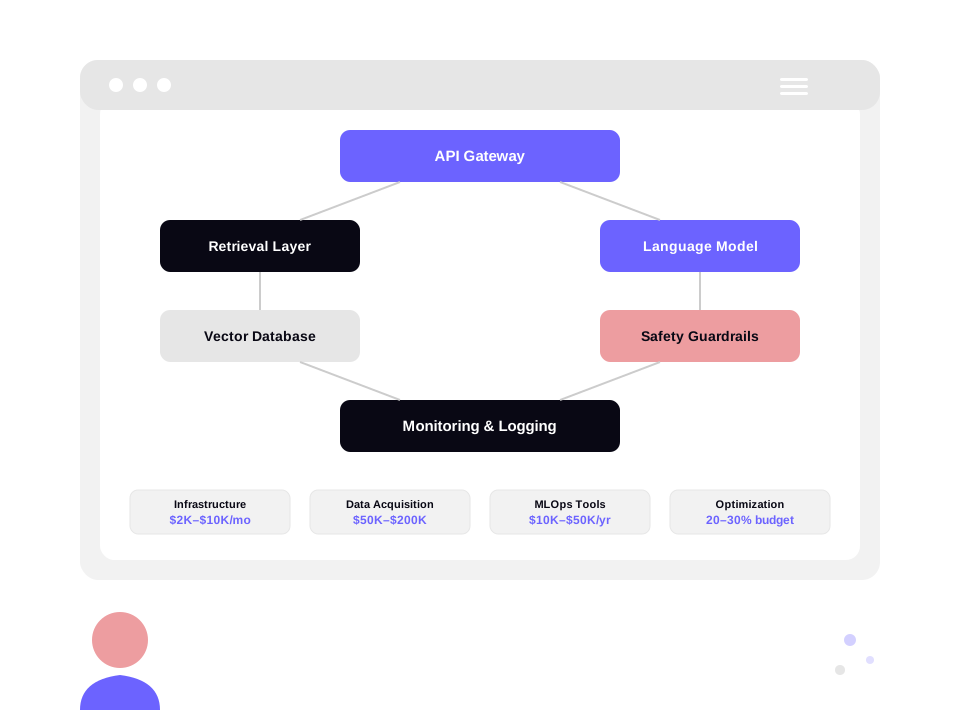
Choosing your LLM architecture is a balancing act between performance, cost, and how much complexity you want to manage. The right answer depends on your specific use case and what resources you have available.
- RAG vs. fine-tuning vs. both: RAG shines when you need up-to-date knowledge retrieval. Fine-tuning wins for domain-specific tasks where you need consistent output patterns. Many teams end up combining both.
- Closed-source vs. open-source models: Commercial APIs like GPT-4 or Claude get you running fast with solid reliability. Open-source models (Llama, Mistral) give you more control and can save money long-term.
- Cloud vs. on-prem: Cloud gives you scalability and managed infrastructure. On-prem gives you full data control—important if your compliance requirements are strict.
- Monitoring and safety: You need logging, content filtering, and responsible-AI guardrails from day one to keep things reliable and trustworthy in production.
Data, Testing, and Evaluation
Your LLM is only as good as the data it learns from and the tests you put it through. Getting data management and evaluation right is what separates demos that impress from products that actually work.
- Clean your data pipeline: Collect data systematically, flag and handle PII properly, and set up data contracts so you always know what quality you're feeding the model.
- Automate your evaluations: Test for accuracy, toxicity, hallucination rates, and domain-specific performance on every model update—don't rely on spot-checking.
- Keep humans in the loop: Expert reviews, structured feedback collection, and versioned model iterations keep quality high as things evolve.

Security and Compliance
Putting LLMs into production means taking security and compliance seriously from the start. You need layered protections that cover your infrastructure, your data, and the model outputs themselves.
- Lock down the infrastructure: Proper secrets management, key rotation, network isolation, and encrypted communications to protect your model pipeline and data.
- Handle sensitive data carefully: Identify PII and PHI systematically, respect data residency rules, enforce retention policies, and use privacy-preserving techniques where possible.
- Stay audit-ready: Log everything, document your models, run red-team tests, and schedule regular compliance reviews to stay ahead of regulatory requirements.

Rolling It Out Step by Step
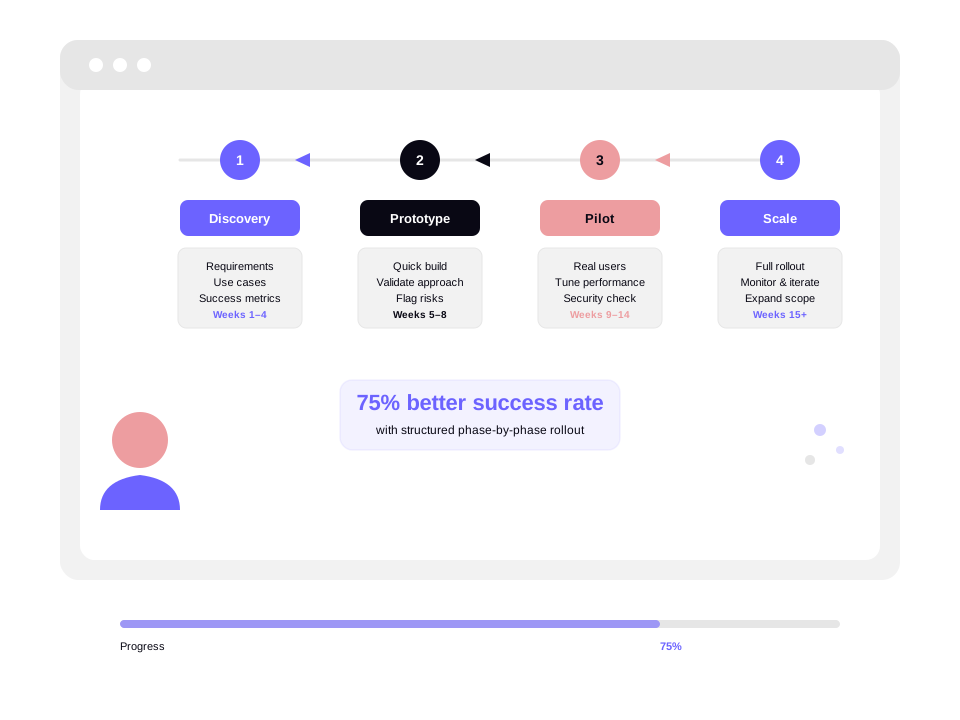
The most successful LLM projects follow a clear path from exploration to full-scale deployment. Teams that work through each phase deliberately see 75% better success rates and get to value significantly faster than those who skip steps.
- Discovery: Understand the business requirements, prioritize use cases, get stakeholders aligned, and define what success looks like with real metrics.
- Prototype: Build something quickly to validate the approach, test your architecture choices, set up initial evaluation, and flag risks early.
- Pilot: Run controlled tests with real users, tune performance, validate security, and make sure operations can handle it before going wide.
- Scale: Roll out across the organization, monitor continuously, improve iteratively, and plan your next wave of expansion.
Ready to put LLMs to work?
Ship LLM-powered features that deliver real, measurable results.
Let's map out your LLM game plan—from picking the right approach to getting it into production.
Consult Our Experts