
Key Takeaways
- AI cuts unplanned downtime, sharpens safety protocols, and boosts production efficiency from the wellhead all the way to the refinery.
- Success depends on clean sensor data, well-defined data contracts, and an MLOps setup that keeps models reliable over time.
- Start with a single KPI -- downtime, throughput, or safety incidents -- and pilot on one asset or field before expanding.
Why the Energy Sector Is Betting on AI
Oil and gas companies operate under a unique mix of pressures: volatile commodity prices, high-stakes safety requirements, aging infrastructure, and growing scrutiny on emissions. AI does not eliminate those challenges, but it gives operators the tools to respond faster, predict problems earlier, and squeeze more value out of every barrel.
Early adopters are already seeing the payoff. Companies that have deployed AI at scale report around 30% improvement in operational efficiency and 40% fewer safety incidents. Just as important, AI helps energy firms track and reduce their carbon footprint -- an increasingly non-negotiable part of doing business.
What AI Actually Delivers
The benefits of AI in oil and gas are not theoretical -- they show up in fewer shutdowns, safer sites, and healthier margins. Here are five areas where the impact is most tangible.
- Less Unplanned Downtime: Predictive models watch vibration, temperature, and pressure data around the clock, flagging equipment issues days or weeks before a failure would halt production.
- Faster, Smarter Drilling: AI tunes drilling parameters in real time -- weight on bit, RPM, mud flow -- to maximize penetration rate and avoid costly non-productive time.
- Fewer Safety Incidents: Computer vision monitors PPE compliance, detects gas leaks, and spots unsafe worker positions, giving safety teams an always-on set of eyes across remote sites.
- Sharper Trading and Logistics: Demand forecasting and route optimization models help procurement teams buy crude at better prices and move products through pipelines and terminals more efficiently.
- Lower Emissions: Continuous monitoring of flaring, venting, and fugitive emissions lets operators act on leaks quickly and report accurate numbers to regulators.

10 High-Impact Use Cases
Below are ten proven applications where AI is moving the needle today. Each one tackles a specific operational pain point and delivers results that show up on the balance sheet.
- Seismic Interpretation and Prospect Ranking: ML models scan 3D seismic volumes to highlight geological features and rank drilling prospects, reducing exploration risk and speeding up lease decisions.
- Real-Time Drilling Optimization: Algorithms adjust drilling parameters on the fly based on sensor readings, cutting well-delivery time and reducing tool wear.
- Production Forecasting and Reservoir Modeling: Decline-curve and physics-informed models predict well output and guide decisions on artificial lift, water injection, and infill drilling.
- Predictive Maintenance on Rotating Equipment: Vibration and thermal sensors paired with failure-prediction models keep compressors, pumps, and turbines running and reduce maintenance spend.
- Pipeline Leak Detection: Acoustic, fiber-optic, and pressure-wave models catch leaks within minutes, limiting spills and avoiding regulatory fines.
- Refinery Yield Optimization: Process models adjust temperatures, pressures, and catalysts in real time to maximize the yield of high-value products from each barrel of crude.
- Supply Chain and Trading Analytics: Price-prediction and logistics models improve crude sourcing, product placement, and hedging strategies.
- Computer-Vision Safety Monitoring: Cameras at rigs and plants detect PPE violations, restricted-area intrusions, and near-miss events automatically.
- Emissions Monitoring and Reporting: Sensor networks and satellite imagery feed models that quantify methane leaks, flaring volumes, and overall carbon intensity.
- Contract and Permit Document Automation: NLP tools extract key clauses from contracts, flag compliance risks, and speed up permitting workflows.
The Technology Stack Behind It
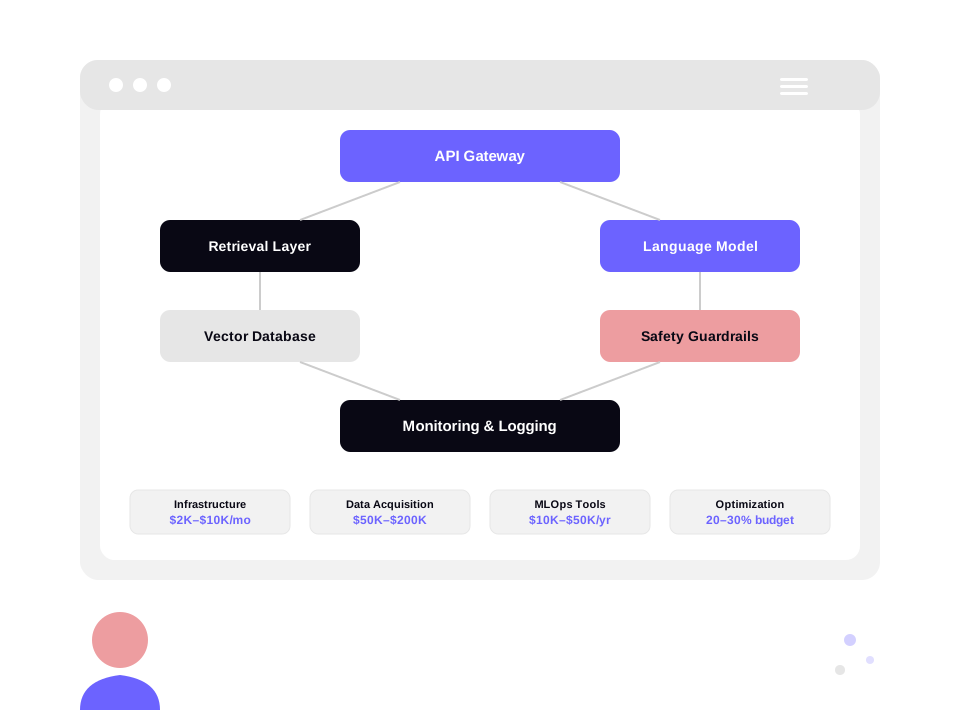
Oil and gas AI runs on a stack that starts with ruggedized sensors and edge devices in the field, pushes data through secure pipelines to the cloud, and serves predictions back to control rooms and mobile apps. The whole thing has to work in remote locations, extreme temperatures, and hazardous zones.

How to Get Started Without Overcommitting
You do not need a multi-year transformation program to start seeing value from AI. The smartest operators begin with a single asset, prove the model works, and expand methodically -- always respecting the safety and regulatory realities of the energy business.
- Pick One KPI and One Asset: Decide whether you are going after downtime reduction, throughput gains, or safety improvement. Then choose a specific platform, well pad, or refinery unit for the pilot.
- Sort Out Data Access and Quality: Establish data contracts with the teams that own sensor feeds. Clean, well-documented data is the single biggest predictor of AI project success.
- Stand Up MLOps Early: Deploy monitoring, drift detection, and automated retraining pipelines from day one. In safety-critical environments, you cannot afford to discover a stale model the hard way.

Let's Talk Energy AI
We help oil and gas teams deploy AI that actually works -- on the rig, in the plant, and in the back office.
We will design your pilot, set up the data pipeline, and get your first model into production.
Consult Our Experts